To lower your golf handicap you do not need to hit it further: you need to stop giving shots away. Most club golfers ruin more cards with two penalties and a three-putt than with twenty metres less off the tee. And there is one decision, taken before any practice session, that changes your score from the very first round: playing from the tee that suits you. At La Roca Golf, choosing well among the five starting options on each hole can be worth more shots than a month of lessons.
The essentials in 20 seconds
- Measure before you change anything. Three rounds noting where each shot goes missing will tell you what to practise. Without that, you practise what you enjoy rather than what costs you.
- The right tee is worth real strokes. With the same index, your playing handicap changes with the tee: at La Roca Golf the course runs from 5,976 metres off the longest to 4,541 off the shortest.
- Shots disappear near the green. Extra putts, short approaches and failed bunker escapes add up faster than long game errors.
- Only registered cards count. If you play outside competition, the round has to be declared beforehand for it to count towards your handicap.
What lowering your handicap actually means
Two things get confused daily. Your handicap index is a number that travels with you and does not depend on the course. Your playing handicap is the one you write on the card at a specific course, and it comes from a World Handicap System formula that accounts for how hard that particular set of tees plays:
Playing handicap = Index × (Slope ÷ 113) + (Course Rating − Par)
With La Roca Golf’s official ratings this stops being theory. The course is a par 71, and the tees are rated like this: Course 1 has a Course Rating of 72.5 and a Slope of 129; Course 3, a Course Rating of 68.0 and a Slope of 126.
Run the formula for a player with an index of 20 and you see the effect: off Course 1 the playing handicap comes out at 24, off Course 3 at 19. Same player, same day, five strokes apart. If the concept is still fuzzy, our guide to what a golf handicap is starts from the beginning.
Lowering your handicap means improving the index, and the index moves with your best recent scores. Which is why the sensible strategy is not to sign one heroic round but to raise the floor: get rid of the disasters.
Measure before you change anything
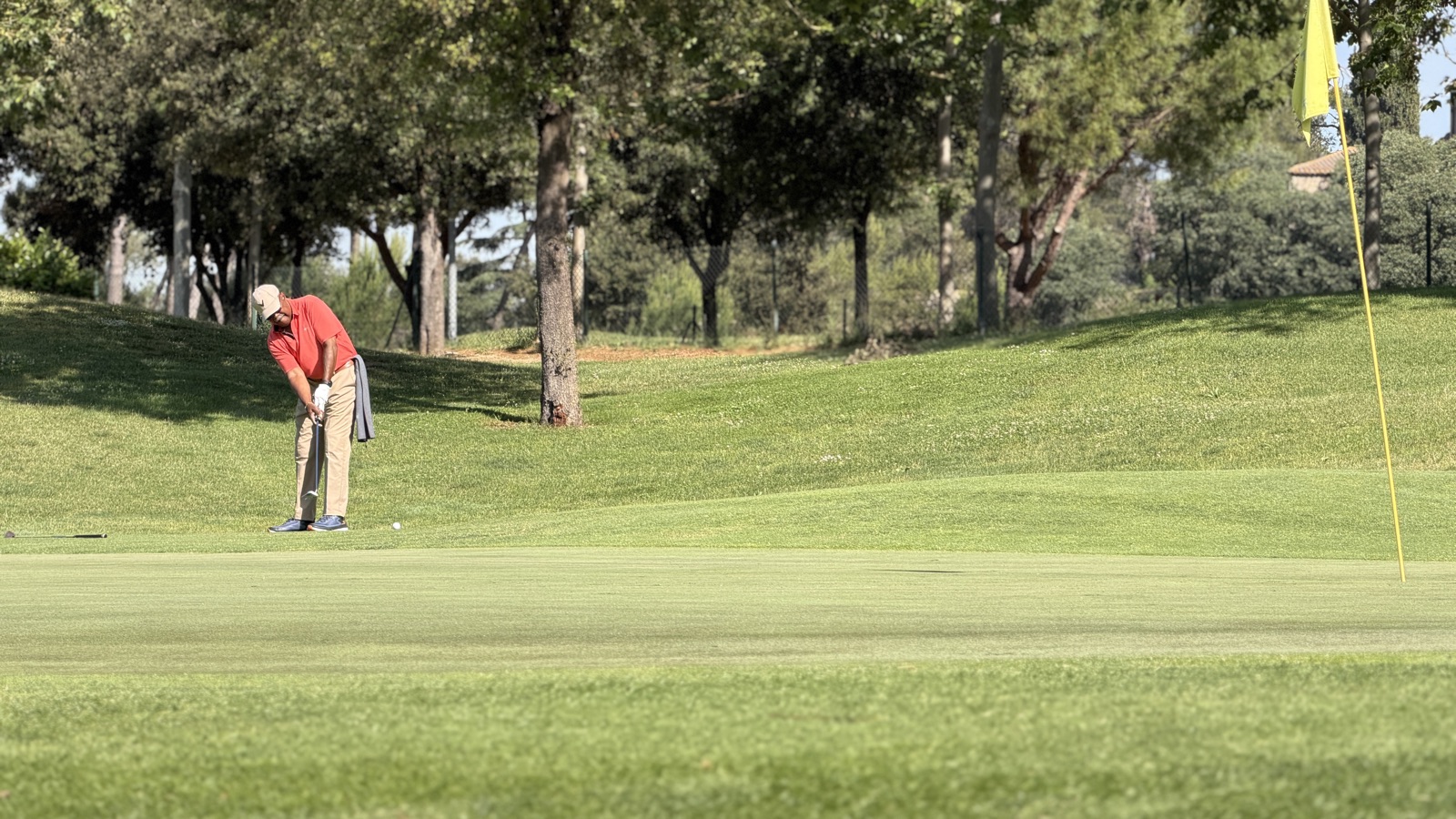
Before signing up for anything, play three rounds with one extra note on the card. On every hole, write down how many putts you took and where you dropped shots: tee shot, approach, short game, bunker or penalty.
By the end of the third round you will have a pattern, and it is rarely the one you expected. Plenty of players convinced their driver is the problem discover they are taking thirty-eight putts a round. Others want swing lessons when what sinks them is two balls in the water per round from attempting shots that come off once in ten.
That notebook is your practice plan. Without it, you will spend your range hours on whatever you are already good at, because that is the fun part.
Where a club golfer’s shots actually go
When you do that exercise, the shots usually spread across these four sources:
- Three-putts. The most expensive and the most trainable. Going from thirty-six putts to thirty-two is four shots without touching your swing. Start with distance control on long putts, which is what prevents the third one, then work through our guide on improving your putting.
- Approaches from inside 100 metres. The distance you play most and practise least. Our short game article goes straight at it.
- Penalties. Out of bounds, water, unplayable lies. They almost always come from attempting the shot that works one time in ten. This one improves through better decisions, not more practice.
- The same old repeated faults. The ones you have carried for years because nobody has watched them from outside. The most common are collected in common golf mistakes.
Play the tee that suits you
This is the most profitable advice in the article and the least followed, because there is some pride involved.
La Roca Golf has five starting options on every hole, and the gap between the farthest and the one closest to the green is almost 1,500 metres: 5,976 metres off the first and 4,541 off the fifth. These are not nuances, they are two different golf courses.
Playing too far back turns par 4s into disguised par 5s: you come in with a long iron or a wood, you miss, and every hole leaks a shot. Moving one set forward leaves you mid-iron approaches, which is the distance from which a club golfer genuinely attacks flags. The cards improve on their own, and the index with them.
An honest way to choose: think about the club you have left for your second shot on a mid-length par 4. If you are reaching for a 4 or 5 iron, you are playing too long.
Practise with data, not with feelings
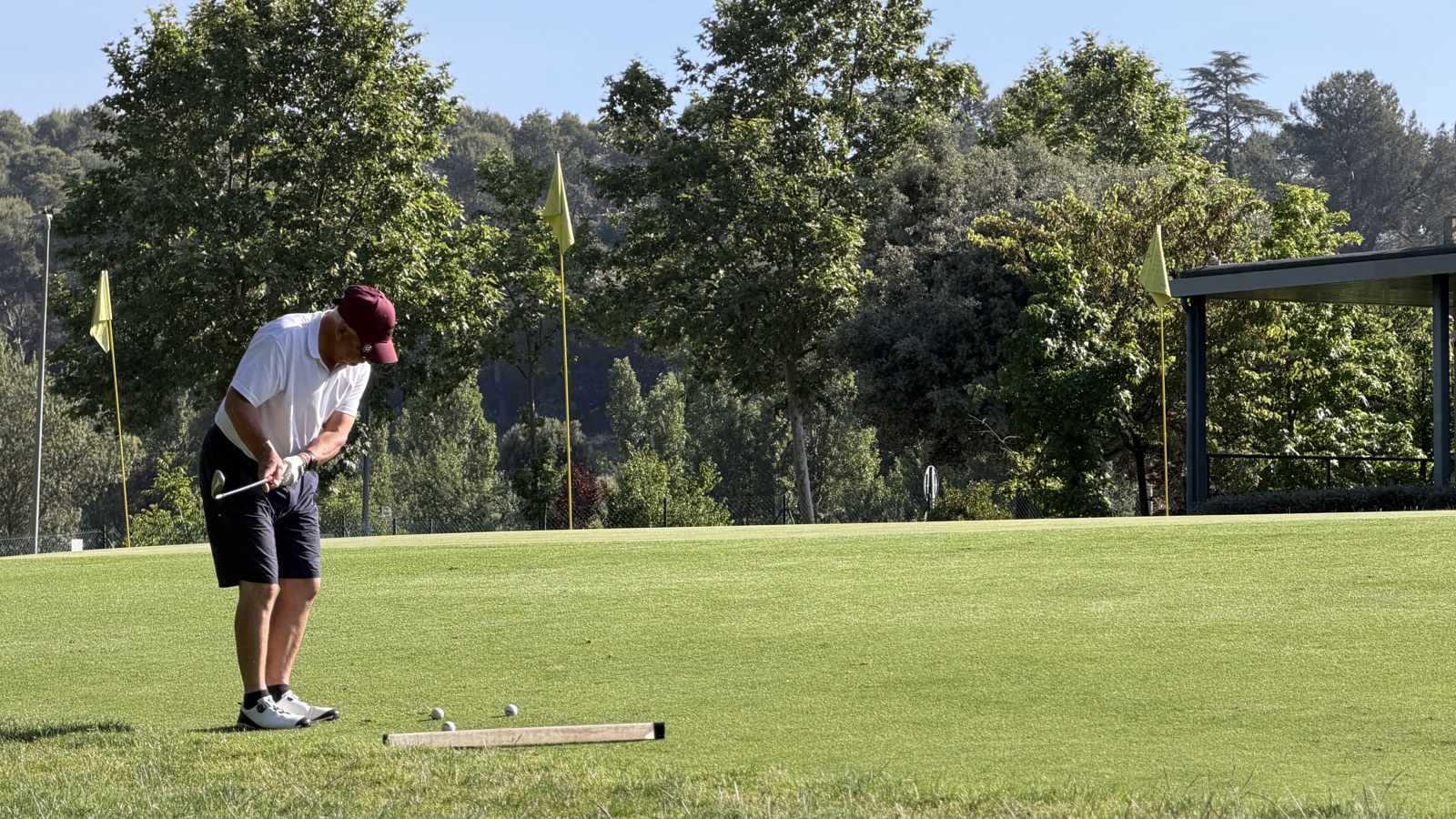
Blind practice cements errors. Hitting a hundred balls in a row with the same club, no target and no reference, mostly trains fatigue.
At La Roca Golf’s training centre you can do this with numbers in front of you. The driving range has Toptracer Range on ten bays, tracing the flight of every ball and giving you real carry rather than the distance you think you hit: the fastest way to discover your 7 iron does not fly what the chart claims. For finer work, the Swing Lab runs Trackman 4, the same analysis technology the professionals use.
With that data a practice session starts to look like training: six balls at a specific target, change club, six more, write it down. And if the pattern in your notebook points to a genuine technical fault, that is where a lesson at La Roca Golf Academy pays off, because you arrive knowing what you want to fix.
Register your rounds or nothing moves
A detail that costs players strokes every year: a good round that is never registered does not exist as far as your handicap is concerned.
Competition cards count automatically. Rounds played outside competition have to be declared in advance under the World Handicap System, before you tee off, and the procedure depends on your own federation. If you hold a licence from outside Spain, ask at reception before your round so the card can be handled correctly, because declaring it afterwards does not work.
That is why club tournaments are the easiest route: you play, you hand the card in, and it counts. You also compete under real pressure, which is where you find out whether an improvement has actually stuck.
Frequently asked questions about lowering your handicap
How much can you lower your handicap in a year?
It depends where you start. A player with a high handicap can come down a long way in one season simply by removing penalties and three-putts, because there is so much room. The lower the handicap, the more each shot costs, and below single figures progress is measured in decimals.
What pays off more, the long game or the short game?
It depends on your notebook, which is why measuring comes first. That said, for most club golfers the shots pile up near the green: putts, short approaches and bunker escapes.
Is lowering your handicap the same as lowering your index?
Not quite. The index is your portable number; the playing handicap is calculated for each course and each set of tees with the World Handicap System formula. Genuine improvement means the index coming down.
How many rounds does it take for my handicap to move?
Your index is recalculated from your recent scores, so the more valid cards you return, the more representative it is and the sooner it reflects your improvement. Playing and registering regularly matters as much as practising.
Is it worth changing clubs to lower my handicap?
Adjusting equipment helps once your strike is consistent, not before. A Swing Lab session with Trackman will tell you whether your shafts and lofts are costing you shots or whether the problem lies elsewhere.
Start your golf journey at La Roca Golf
Lowering your handicap is not about one miracle shot: it is about measuring, choosing the right tee, practising what fails and registering your cards. Less glamorous than chasing twenty extra metres off the tee, and considerably more effective. At La Roca Golf, 30 minutes from Barcelona, you have Toptracer on the range, the Swing Lab with Trackman and the Academy to put a method behind it all.
Check our services and rates and book your next session.