To improve putting you don’t need to rebuild your swing or hit the ball harder: you need to practise the stroke you repeat most on a round and train the least. The putt is the stroke that saves the most shots on your card, and also the cheapest to improve, because it asks for no strength and no special fitness. With a solid routine, a bit of green reading and some distance control, almost anyone drops their putt count within a few weeks. At La Roca Golf, 30 minutes from Barcelona, the 1,000 m² putting green at the Training Centre is exactly the place to do it.
Whether you play at home or are golfing near Barcelona on holiday, this guide gets straight to it: what to check before you strike, how to train distance and which mistakes are costing you holes without you noticing.
The essentials in 20 seconds:
- Why it matters: putting can be close to half your shots on a round, so it’s the fastest way to lower your score
- Distance first: leaving the ball close (not holing it) is what prevents three-putts
- A fixed routine: read, aim, a couple of practice strokes and always the same stroke gives you consistency
- Where to practise: on a real putting green with real slopes, like the 1,000 m² one at La Roca Golf
Why putting is where you gain the most
Add up your last round. If you shot 90, chances are 30 to 40 of those were putts: nearly half your card settled with the smallest club in the bag. And yet, at the practice ground almost everyone heads straight for the driver and leaves putting for last, when there’s no time or energy left.
That’s the opportunity. The putt has the best effort-to-result ratio in golf. It asks for no power, no flexibility, no years of technique: it asks for repetition and a clear head. A beginner can become a good putter far sooner than a good ball-striker, and an experienced player lowers their handicap more by sharpening the putt than by chasing twenty extra metres off the tee.
If you’re starting out and want a broader roadmap, we have a guide on how to start playing golf that lays out where to begin. But if you already play and want a quick win, stay here: the putt is your shortcut.
First of all: control distance, not line
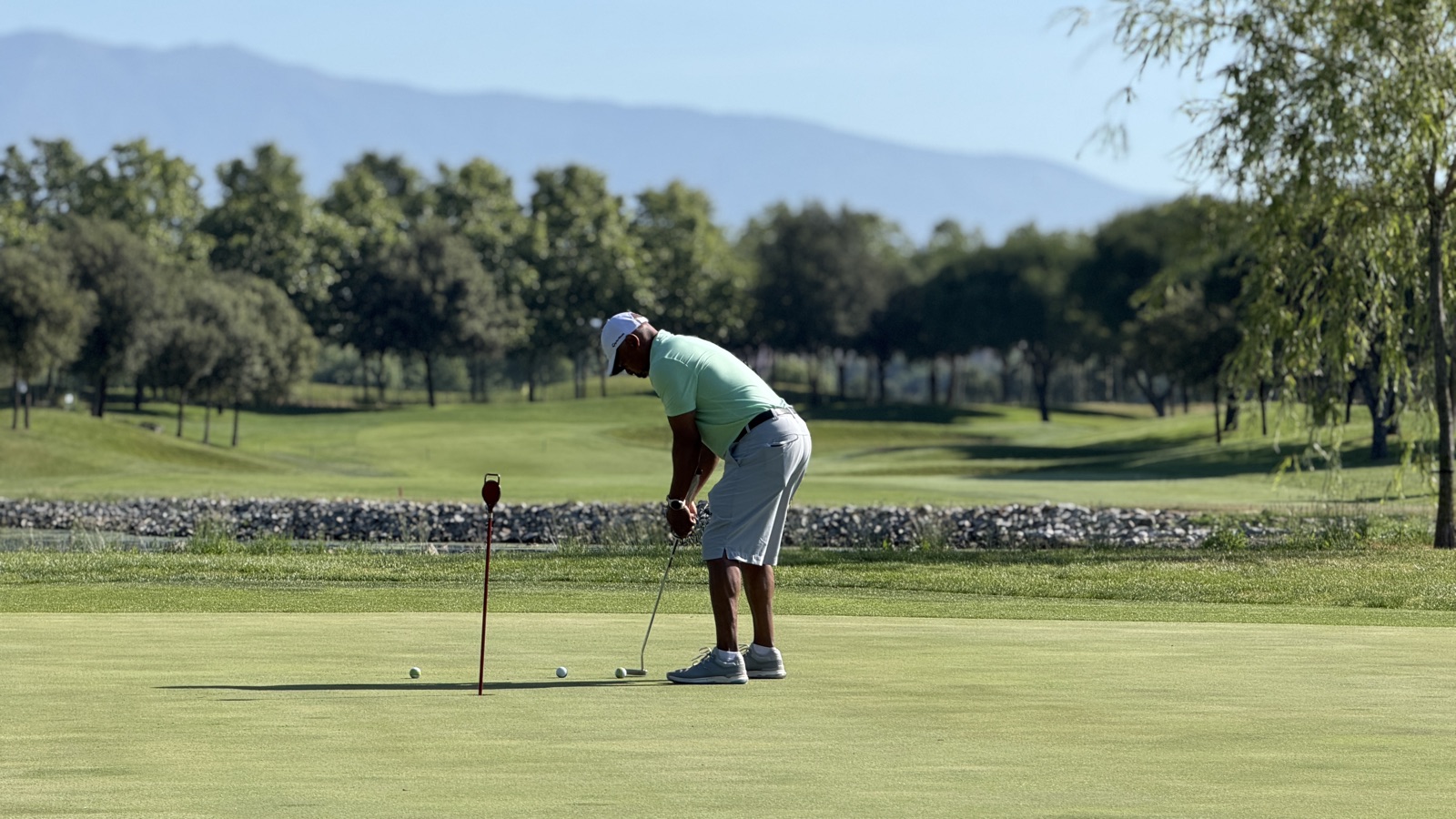
The most common mental error is obsessing over holing the putt. On long putts, the goal isn’t to sink it, it’s to leave the ball a hand’s width from the hole to secure the next one. Players who control distance rarely three-putt; players who only think about line run it past or leave it short and sign for silly bogeys.
Distance is trained through the length of the pendulum, not through force. The putt is a shoulder movement, like a clock: the longer the swing back and through, the further the ball rolls, always at the same tempo. Hitting harder for a long putt is exactly what wrecks your touch.
A simple, brutal drill: place three balls at different distances from the edge of the green and try to make each one stop in the last metre before dropping off, without actually rolling out. You’re not aiming at a hole, you’re aiming at a zone. Ten minutes of that beats half an hour holing one-footers. On a wide putting green with genuine slopes, the drill makes sense; that’s why practising distance on a mat at home is misleading.
Learn to read the break
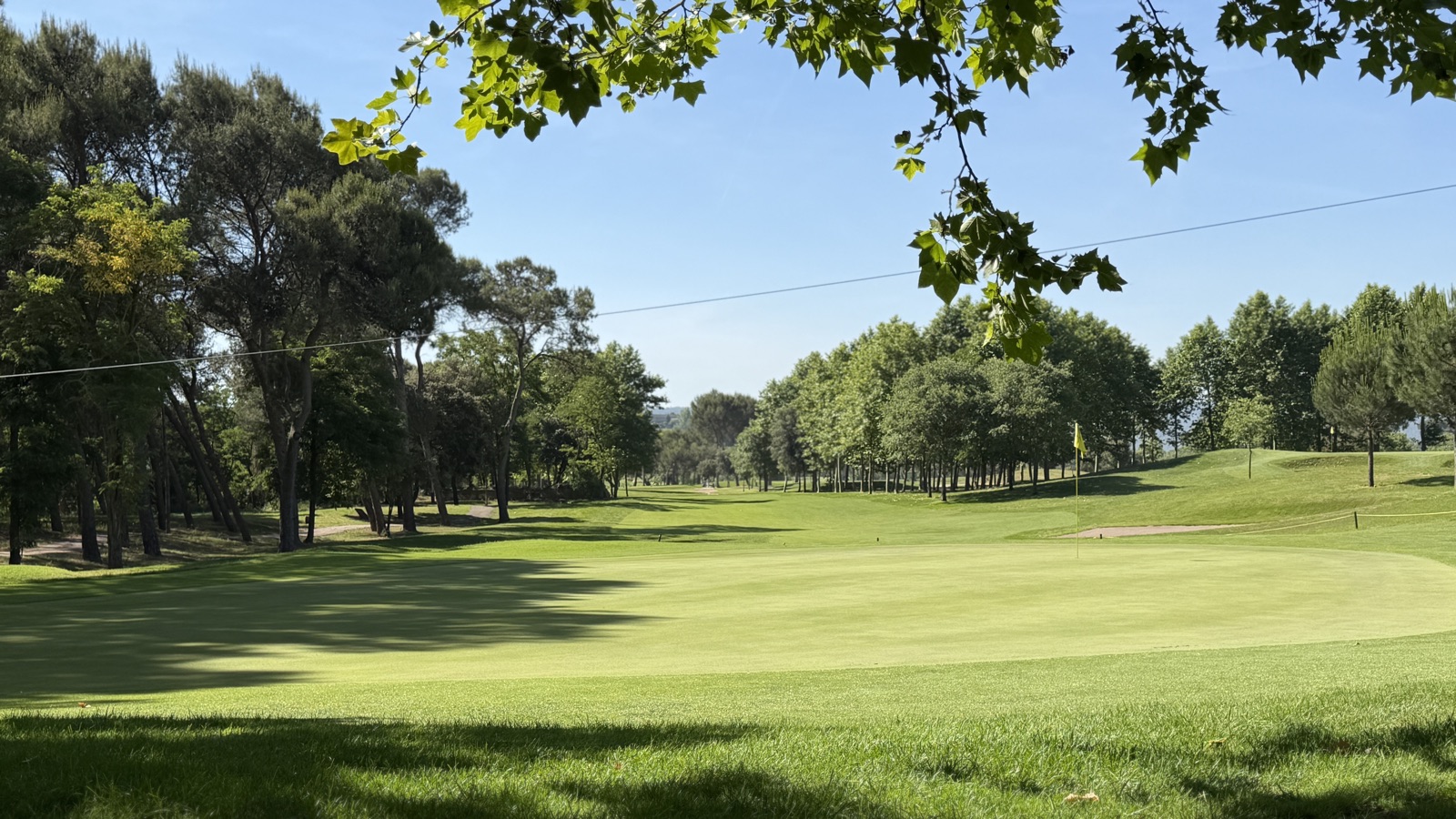
Once you control distance, line comes down to reading the ground. The ball always falls towards the lowest point of the green, and your job is to guess how much it will move before it reaches the hole. It becomes intuition with practice, but start with three concrete steps:
- Look at the whole thing from behind the ball. Crouch behind the putt, line up your eyes with ball and hole, and see which way the green tilts. The slope is almost never completely flat.
- Read the surroundings. Water drains downhill: if there’s a lake, a bunker or a lower area nearby, the break usually runs towards it. On an open, visible course like La Roca’s, with a clear view from tee to green, reading the contour is easier than on a tight layout.
- Pick an aim point, not the hole. On a breaking putt you don’t aim at the hole, you aim at the point where the ball will start to turn. Choose that point, trust it and let the slope do the rest.
The golden rule: when in doubt, play less break than you think and a touch firmer. A firm putt holds its line better, and a ball with pace “holds” the slope better than one dying as it arrives.
Build a routine and repeat it every time
Good putters don’t improvise. They have a short routine they repeat on every putt, and that repetition is what gives consistency under pressure. It doesn’t need to be long or solemn; it needs to be always the same:
- Read the break from behind the ball.
- Choose your aim point and the pace.
- Align the putter face square to that line, with your eyes over the ball.
- Take one or two practice strokes looking at the hole to feel the distance.
- Strike without a second thought. Trust the read you’ve already made.
Step five is the hardest and the one that matters most: once decided, nothing gets rethought. Most missed putts aren’t about bad technique, they’re about hesitating mid-stroke. A calm shoulder movement, head still until the ball leaves, then look up for the result. This kind of unhurried, ordered work is exactly what a coach trains well; if you’re interested, La Roca runs golf lessons where the putt gets its share of attention.
The three mistakes that cost the most putts
Before you head to the green, keep in mind the three errors that cost the most and are easy to fix:
- Moving your head to see if it drops. Looking up too early opens the putter face and pushes the ball offline. Keep your eyes on the spot where the ball was until a second after impact.
- Gripping with tension. Rigid hands kill the touch. The putter is held softly, almost like holding a tube of toothpaste without squeezing it.
- Only practising short putts. Holing one-metre putts feels good but misleads you: the strokes that ruin cards are the badly judged long ones. Spend most of your practice on distance.
The putting green at La Roca Golf
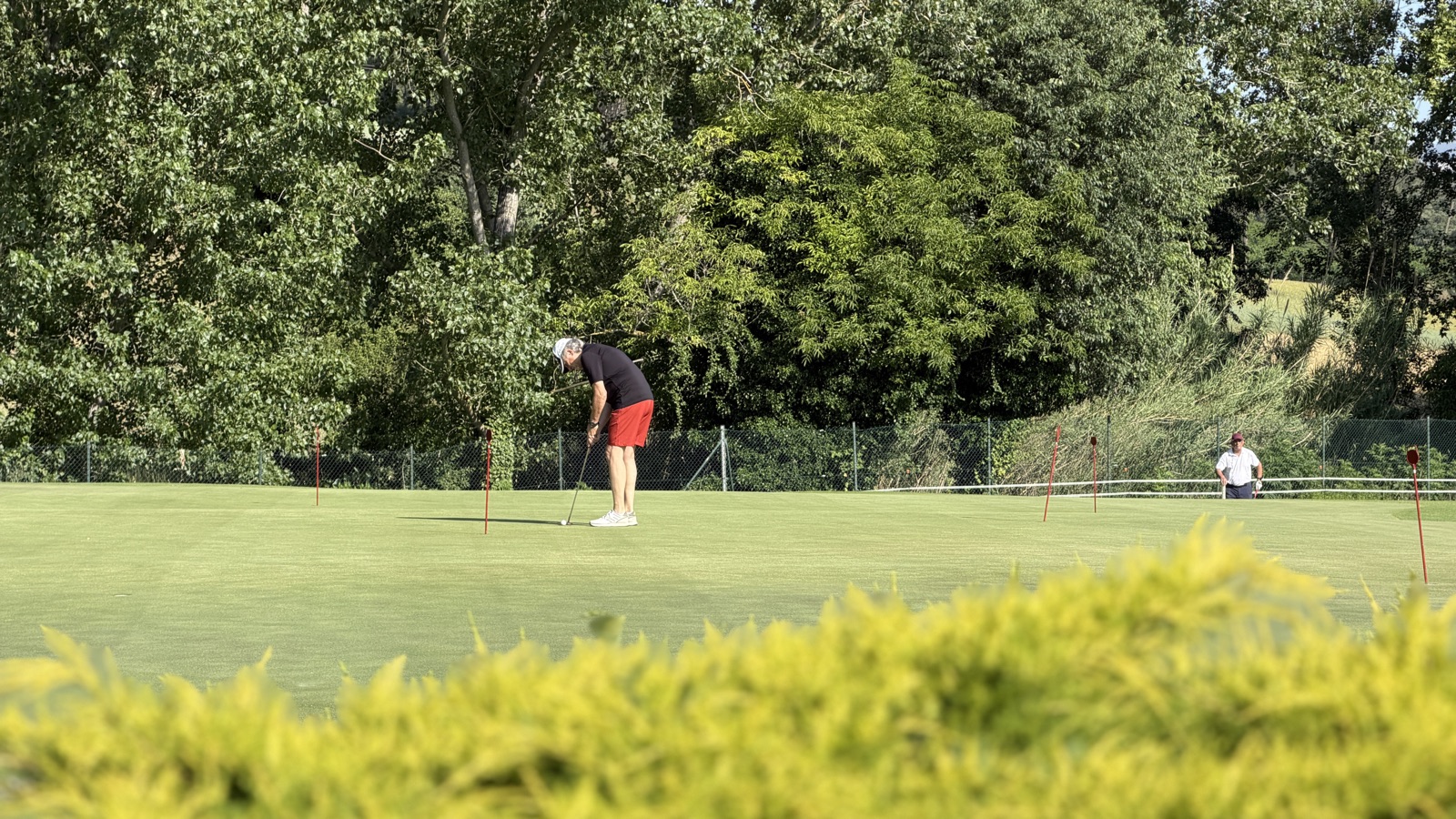
Training all this needs a real surface, and that’s where the difference lies. The Training Centre at La Roca Golf has a 1,000 m² putting green with real slopes, the ideal space to practise distance and reading without the limits of a home mat. Right beside it, the short-game area brings together over 10,000 m² of real playing turf and the driving range with Toptracer across 10 bays, so the putt is trained within a complete setup, not in isolation.
The setting helps: a flat, open course 30 minutes from Barcelona, with a clear view from tee to green, makes reading the contour of the ground come naturally. And as the club’s philosophy, golf here is amateur and for every level: it doesn’t matter whether you’ve come to sign your first three-putt-free round or to polish a low handicap, the green is the same and so is the place.
If you’d rather begin with method before going it alone, La Roca Academy works on the game all year round, and a beginner course is a good way to set the putting technique from the start, without habits that are hard to unlearn later.
FAQs about how to improve putting
What’s the first thing I should improve in putting?
Distance control. Before holing putts, learn to leave the ball near the hole on long putts: that’s what eliminates three-putts, which cost the most shots on a round.
How do you read the break on a green?
Look at the putt from behind the ball, see which way the green tilts (water drains to the lowest point) and pick an aim point where the ball will start to turn, not the hole. When in doubt, play less break and strike a little firmer.
How long until I notice improvement?
With short, frequent sessions, many players notice fewer putts within a few weeks. Practising fifteen minutes several times a week is more effective than one long session: putting is built on repeating the same stroke.
Is it worth practising putting at home on a mat?
For the routine and the stroke, it helps a little; for what matters, no. Distance control and green reading are only trained on a real putting green, with real surface and real slopes.
Can I practise putting at La Roca Golf?
Yes. The Training Centre has a 1,000 m² putting green with real slopes, plus the driving range with Toptracer and the short-game area. Options and availability are confirmed directly with the club.
Start lowering your putts at La Roca Golf
Improving your putting isn’t about talent, it’s about giving the most important stroke the practice almost nobody gives it. Distance, reading and a routine you repeat every time: with that, your score comes down on its own.
Want to train your putt on a real putting green? Check options and availability on the services and rates page or drop by the Training Centre at La Roca Golf, 30 minutes from Barcelona.
Content reviewed by La Roca Golf Academy.