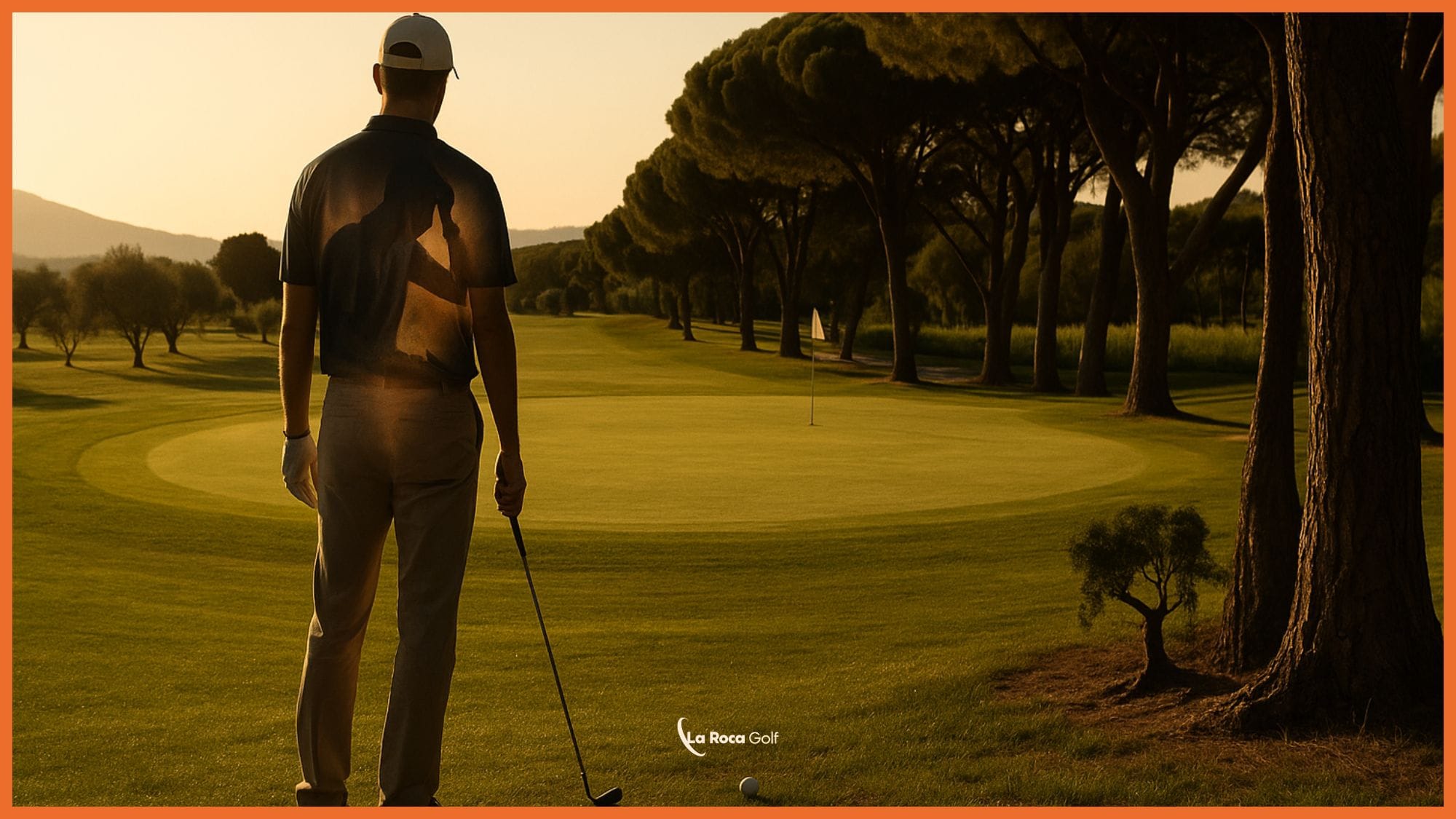
Did you know that professional golfers miss 60% of their putts from 2 meters? However, the world’s best players have learned something that goes beyond technique: mental resilience. This quality not only determines your final score but can completely transform your life experience.
Golf resilience represents your ability to maintain composure after a missed shot, adapt to changing conditions, and persevere when results aren’t as expected. In a sport where we spend more time recovering from mistakes than celebrating successes, this skill marks the difference between enjoying each round or turning it into a frustrating experience.
At La Roca Golf, we’ve observed for years how players who develop this mindset not only significantly improve their game but also transfer these benefits to their personal and professional lives with extraordinary results.
What is Golf Resilience and Why is it Crucial?

Golf resilience goes far beyond “enduring” a bad shot. It’s about a specific mental strength that includes:
Key components of golf resilience:
- Emotional regulation: Controlling frustration and anxiety in real-time
- Cognitive flexibility: Adapting strategies according to circumstances
- Intelligent persistence: Maintaining effort without falling into stubbornness
- Accelerated recovery: Returning to optimal state after setbacks
This skill is fundamental because golf presents a unique challenge: each shot is a new opportunity for failure or success, and you can’t blame teammates or external factors. It’s just you, your mind, and the ball.
Studies in sports psychology from the American Psychological Association demonstrate that mental resilience can improve performance by up to 23% compared to players with similar technical ability but lesser psychological strength.
The Scientific Benefits of Resilience
Recent research in sports neuroscience reveals that developing golf resilience generates measurable brain changes:
Documented neurological changes:
- Strengthening of the prefrontal cortex (decision-making)
- Reduction in amygdala activity (stress response)
- Improvement in neuroplasticity (learning capacity)
- Increase in BDNF production (neurotrophic factor)
A study from Stanford University published in the Journal of Applied Sport Psychology followed 200 golfers for 18 months, finding that those who practiced mental resilience techniques reduced their handicap by an average of 4.2 points more than the control group.
7 Practical Lessons to Develop Resilience

Lesson 1: Master the Radical Acceptance of Imperfection
The first pillar of resilience is deeply understanding that perfection in golf is mathematically impossible. Even Tiger Woods, in his prime, missed approximately 30% of his approach shots.
Practical implementation:
The “70-20-10” technique:
- 70% of your shots will be satisfactory
- 20% will be exceptional
- 10% will be disappointing
Accept this distribution before each round and celebrate when you exceed these statistical expectations.
Post-error self-compassion exercise:
- Acknowledge the error without judging it (“It was an imprecise shot”)
- Remember that all golfers fail regularly
- Talk to yourself as you would to a good friend
At our La Roca Golf course, specifically designed to be “forgiving” to the player, you’ll find the perfect environment to practice this acceptance, with multiple recovery options even when a shot doesn’t go as expected.
Lesson 2: Build an Unbreakable Pre-shot Routine
Pre-shot routines act as mental anchors that return you to the present moment, especially under pressure. Consistency in this routine is more important than swing perfection.
The 5 elements of a resilient routine:
- Specific visualization (15 seconds)
- Imagine the exact trajectory of the ball
- Visualize the precise landing point
- See the ball rolling toward the target
- Activating breathing (10 seconds)
- Inhale deeply for 4 seconds
- Hold the air for 2 seconds
- Exhale slowly for 6 seconds
- Practice swing with intention (10 seconds)
- Execute the exact movement you plan to make
- Feel the kinesthetic sensation of the perfect swing
- Conscious alignment (15 seconds)
- Position yourself with millimetric precision
- Verify posture and grip
- Confident execution (3 seconds)
- Strike without additional thoughts
- Trust completely in your preparation
At our training center with Toptracer Range technology, you can perfect this routine while receiving immediate feedback and precise data about your results.
Lesson 3: Develop the Art of Rapid Emotional Recovery
The most valuable skill in golf isn’t avoiding mistakes, but recovering quickly from them. Resilient golfers have a “selective memory” that preserves positive experiences and constructively processes negative ones.
60-Second Emotional Recovery Protocol:
Phase 1: Recognition (10 seconds)
- Allow yourself to feel the frustration completely
- Don’t suppress the emotion, acknowledge it
Phase 2: Closing ritual (15 seconds)
- Execute a specific physical action (adjust glove, clean club)
- This gesture symbolizes “closing” that moment
Phase 3: Positive refocus (20 seconds)
- Identify a specific lesson from the error
- Visualize the next shot executed perfectly
Phase 4: Future activation (15 seconds)
- Walk purposefully toward the next shot
- Repeat mentally: “The next shot is the most important”
This technique, refined over years in our weekly tournaments, has helped hundreds of players maintain consistent scores even after particularly challenging holes.
Lesson 4: Master Strategic Adaptability
Resilient golfers don’t fight against adverse conditions; they integrate them into their strategy. This mental flexibility is transferable to any life situation where circumstances change unexpectedly.
The A.D.A.P.T. Model for variable conditions:
- Analyze conditions objectively
- Define realistic adjusted expectations
- Adjust your game strategy
- Prioritize smart decisions over risky shots
- Take advantage of unique opportunities
Practical application by conditions:
Strong wind (>20 km/h):
- Reduce expected distance by 15-20%
- Select clubs with more loft for greater control
- Aim for center of greens instead of flags
Light rain:
- Slightly increase grip pressure
- Slow down swing tempo by 10%
- Prioritize accuracy over distance
Fast greens:
- Reduce force on long putts by 20%
- Focus on speed before line
- Accept defensive putts to avoid three-putts
At La Roca Golf, with our five strategically differentiated tees, you have perfect flexibility to adapt your strategy according to daily conditions, choosing the course that best fits circumstances and your confidence level.
Lesson 5: Cultivate Patience as a Mental Superpower
Developing mental strength in golf requires almost zen-like patience. Progress is rarely linear, and the most significant advances often come after apparent periods of stagnation, what sports psychologists call “productive learning plateaus.”
This deep patience is directly related to the benefits of golf for longevity, where persistence and long-term mentality become valuable assets for both game and life.
Strategies to cultivate deep patience:
1. Process vs. results objectives
- Incorrect: “I want to reduce my handicap by 5 points this year”
- Correct: “I will improve my pre-putt routine and practice 30 minutes of short game each session”
2. The micro-progress diary
- Record 3 small improvements after each round
- Note patterns in your emotional game, not just technical
- Celebrate consistency over exceptional results
3. The 1% daily rule
- Focus on improving one microscopic aspect each day
- Can be as simple as maintaining better swing tempo
- Experts confirm that 1% improvements compound exponentially
At our golf academy, our programs are specifically designed respecting these principles of gradual development, helping you build your game sustainably and with deep patience.
Lesson 6: Use Breathing as Performance Technology
Conscious breathing is the most powerful and underestimated tool in golf. It directly activates your parasympathetic nervous system, reducing cortisol and improving neuromuscular coordination in seconds.
These techniques complement perfectly with golf meditation practices, creating a powerful synergy for mental strength development.
Golf-specific breathing techniques:
4-7-8 breathing for extreme pressure:
- Inhale counting to 4
- Hold air counting to 7
- Exhale slowly counting to 8
- Repeat 3 times before decisive shots
Post-error recovery breathing:
- 3 deep abdominal breaths
- Each exhalation longer than inhalation
- Imagine physically exhaling frustration
Pre-round activation breathing:
- 5 energizing breaths
- Quick and vigorous inhalations
- Controlled exhalations to maintain alert calm
Scientific data: A study from the Barcelona Sports Research Center demonstrated that golfers practicing conscious breathing improve their putting accuracy under pressure by 34% compared to traditional relaxation techniques.
The professionals at La Roca Golf teach these techniques integrated with the swing, creating a golf and wellness experience that goes far beyond traditional sport.
Lesson 7: Transform Golf into Life University
Golf’s deepest lessons are revealed when we begin to see conscious parallels between the course and our daily challenges. This intentional transfer exponentially multiplies the value of each round played.
Golf-life mapping for conscious transfer:
Strategic planning:
- In golf: Evaluating risks of tucked pin vs. center of green
- In life: Analyzing pros/cons before important decisions
- Transferable skill: Strategic thinking under pressure
Emotional management:
- In golf: Maintaining calm after a triple bogey
- In life: Preserving professionalism during work conflicts
- Transferable skill: Real-time emotional regulation
Intelligent adaptability:
- In golf: Adjusting strategy when wind changes
- In life: Pivoting plans when circumstances evolve
- Transferable skill: Cognitive flexibility and resilience
Selective persistence:
- In golf: Knowing when to attack the pin vs. play safe
- In life: Distinguishing between productive perseverance and stubbornness
- Transferable skill: Decision-making with incomplete information
Practical transfer exercise: After each round, identify a specific course situation that resembles a current challenge in your life. Ask yourself: “How would I apply the mental strategy I use in golf to this situation?”
At La Roca Golf, our privileged natural environment and course design that prioritizes player well-being create the perfect scenario for this conscious transfer of learning between golf and life.
How to Transfer Golf Resilience to Your Life

The true magic of developing golf resilience happens when these skills begin to appear automatically in other areas of your life. This transfer isn’t accidental; it requires conscious practice.
Life-golf transfer protocol:
1. Emotional pattern identification
- Notice when you feel in life the same emotions as in golf
- Observe your physical reactions to frustration (tension, breathing)
- Recognize negative automatic thoughts
2. Direct technique application
- Use your 4-7-8 breathing before important meetings
- Apply your closing ritual after work mistakes
- Implement the mental compartment technique in personal conflicts
3. Life routine creation
- Develop pre-presentation routines like your pre-shot routine
- Establish recovery protocols after setbacks
- Create regular positive self-evaluation systems
Participants in our golf and wellness programs report significant improvements in work stress management, personal relationships, and general confidence after just 3 months of conscious practice.
Frequently Asked Questions About Golf Resilience
How long does it take to develop mental resilience in golf?
Initial changes in emotional regulation can be noticed after 2-3 weeks of consistent practice. However, deep resilience typically develops between 6-12 months of conscious work.
The key is daily consistency rather than intensity. 15 minutes daily of mental practice is more effective than sporadic 2-hour sessions.
Typical development timeline:
- Weeks 1-3: Greater emotional awareness
- Months 2-3: Consistent technique implementation
- Months 4-6: Automation of resilient responses
- Months 7-12: Natural transfer to daily life
What to do when pressure is too intense during a tournament?
During competitions, pressure can intensify beyond what you experience in casual rounds. Here’s your emergency protocol:
S.O.S. technique for extreme pressure:
- Simplify: Reduce your routine to essentials
- Oxygenate: 3 deep abdominal breaths
- Smile: Physiologically activate a positive state
Tournament-specific strategies:
- Accept that being nervous is normal and productive
- Focus on processes, not results or positions
- Use positive self-talk: “This pressure means I care”
- Remember that all other players feel similar pressure
At our regular tournaments in Barcelona, we create an environment that progressively helps you get used to competitive pressure in a gradual and constructive way.
How to apply these techniques if I’m a golf beginner?
Beginners have a unique advantage: they can develop mental resilience from day one, avoiding bad emotional habits that other players must correct later.
Beginner approach:
Priorities in order:
- Fun and enjoyment over scoring
- Learning from every experience, good or bad
- Gradual progress in technical and mental skills
- Extreme patience with the learning process
Adapted techniques:
- Use conscious breathing even at the driving range
- Celebrate small achievements (solid contact, correct direction)
- Develop simple routines from the beginning
- Focus on improvement process, not comparisons
For players starting in amateur golf, these mental fundamentals are as important as learning the basic swing.
Our programs at La Roca Golf Academy are specifically designed to teach technique and mentality simultaneously from day one.
Is it possible to be resilient if I have general anxiety?
Absolutely. In fact, golf can be a powerful therapeutic tool for people managing anxiety. Golf resilience techniques are based on scientifically proven cognitive-behavioral therapy principles.
Anxiety adaptations:
- Start with low-pressure practice sessions
- Use breathing techniques more frequently
- Accept that difficult days are a normal part of the process
- Celebrate any moments of calm on the course
Specific golf benefits for anxiety:
- Natural environment that naturally reduces cortisol
- Moderate exercise that improves neurochemistry
- Regular practice of mindfulness and present moment
- Supportive community without intense social pressure
The simple act of walking during a golf round provides additional benefits for emotional regulation and stress management.
Many of our members have found in golf an effective way to manage stress and develop emotional regulation tools that they successfully apply in other areas of their lives.
Conclusion: Your Journey to Resilience Starts Today

Developing golf resilience isn’t simply about improving your score; it’s about building mental strength that enriches every aspect of your life. Each round, each shot, even each frustration, becomes a valuable opportunity to strengthen your ability to navigate challenges with grace and determination.
Your immediate action plan:
- This week: Implement the 4-7-8 breathing technique in your next round
- This month: Develop and practice your personalized pre-shot routine
- Next 3 months: Maintain a micro-progress and life-golf transfer diary
- Long-term: Fully integrate these techniques until they become automatic
At La Roca Golf, with our design that prioritizes player well-being and our philosophy of “We make it very easy for you,” you’ll find the perfect environment to cultivate this essential quality. Our team is trained not only to improve your technique but to help you develop the mental strength that transcends golf.
Ready to transform your relationship with golf and life?
Resilience isn’t a destination you reach; it’s a skill you develop day by day, shot by shot, decision by decision. Start your journey toward an unbreakable mindset today.
Book your next visit to La Roca Golf and start building your resilience in the perfect environment for your personal and athletic development.
Did you find this article useful? Share it with other golfers who could benefit from these techniques and join our community at La Roca Golf to receive more content about golf, wellness, and personal development.