The golf swing exercises that pay off most at home barely need a ball: checking your setup in a mirror, making slow-motion swings, practising with a towel under your arms and rolling a few putts on the rug. Fifteen minutes, three days a week, keeps the movement alive between rounds. So when you arrive for your golf trip to La Roca Golf, 30 minutes from Barcelona, your swing doesn’t start from scratch on the first tee.
At home you can’t see the ball fly, but you can train what sets up a good shot: posture, rotation and the connection between your arms and body. This guide gives you five swing drills, a few strength exercises and a weekly routine to fit it all in.
The essentials in 20 seconds
- What you can train at home: positions, posture, rotation and putting. Ball flight is for the range.
- How much: we suggest 15 minutes of swing work three days a week and, if you can, 15 minutes of strength on two of those days. Little and often beats a lot at once.
- Kit: a mirror, a towel, a short club (or none) and a glass to act as the hole.
- Strength: a review of 20 studies found that strength training increases clubhead speed and distance.
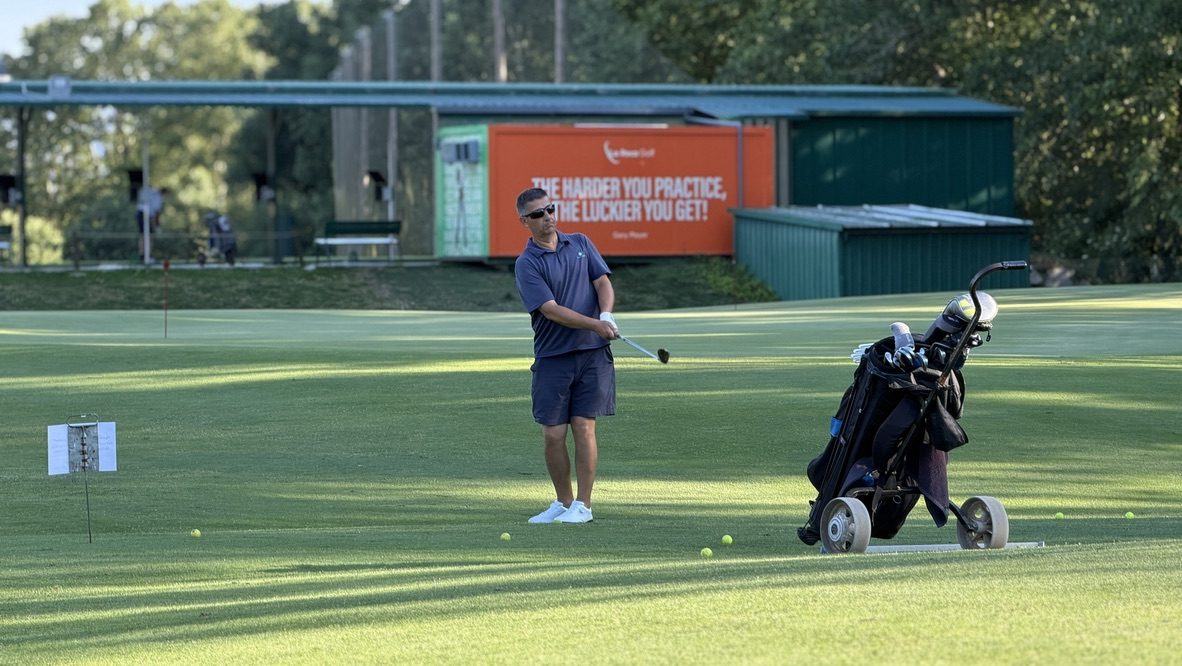
Why training your swing at home works (and what the living room can’t do)
When you hit balls, your attention chases the result: if the ball goes crooked, you fix it with your hands without knowing what happened. At home there’s no result to distract you. You can go slowly, stop in each position and check that your body is where you think it is. That’s why drills without a ball are a good partner to everything in our guide on how to improve your golf swing: fundamentals first, speed later.
What home can’t give you is ball flight. You’ll know whether your posture is right, but not whether the shot goes straight. So these exercises prepare, and the Driving Range confirms.
Safety first: check there are no lamps, low ceilings or people nearby. Use a short club (a wedge or a 9-iron), grip down on it or do the drills without a club. Never swing a driver indoors.
5 golf swing exercises you can do at home
| Exercise | What it trains | Kit | Minutes |
|---|---|---|---|
| Setup in the mirror | Grip, posture and alignment | Mirror and club | 3 |
| Slow-motion swing | The key positions of the swing | Short club or nothing | 3 |
| Towel under the arms | Arm and body connection | Towel | 3 |
| Glute against the wall | Holding posture through the turn | A wall | 2 |
| Putting on the rug | Putting line and pace | Putter, ball and glass | 4 |
1. Setup in the mirror
Stand side-on to the mirror as if you were about to hit. Check: feet shoulder-width apart, knees slightly flexed, back straight and arms hanging relaxed. Then face the mirror and check your grip: both hands together, working as one. Get into your setup, step out of it and set up again, ten times. What you repeat at home becomes automatic on the tee.
2. Slow-motion swing
Swing as slowly as you can and pause for two or three seconds at three points: the club parallel to the ground on the way back, at the top, and the finish with your chest facing the target. If you lose your balance at any point, that’s where the work is. With a low ceiling, make half swings only: they work just as well.
3. Towel under the arms
Tuck a small towel under both armpits and make half swings without letting it drop. It forces your arms and body to turn together instead of the arms going their own way. It’s a classic drill for feeling what a connected swing is.
4. Glute against the wall
Take your setup with your backside touching a wall. On the backswing, your right glute (left if you’re left-handed) stays in contact. If it comes away, you’re pushing your hips towards the ball and standing up, and that changes your strike. Ten slow reps are enough.
5. Putting on the rug
Lay a glass on its side on the floor a metre away and start with a few putts that drop, to build confidence. Then move back to two or three metres and spend most of your time there: work on pace so the ball arrives right at the glass, neither short nor long. On the course, the putts that cost the most shots are long putts with poor pace, so pace deserves more time than the one-metre putt.
Strength exercises that help your swing
Strength can be trained at home too, and it does show in your swing. A review of 20 golf studies concluded that strength training improves clubhead speed and hitting distance. Combining general exercises with golf-specific movements gave, on average, 4.1% more clubhead speed and 5.2% more distance, compared with 1.6% and 4.8% from general strength training alone. The advantage lies mainly in clubhead speed (Uthoff et al., Journal of Strength and Conditioning Research, 2021).
The studies used fuller programmes; these four exercises, with no gym needed, are a starting point at home:
- Squat: strong legs, stable base. Three sets of 10.
- Glute bridge: lying on your back, lift your hips and hold for two seconds. Three sets of 12.
- Side plank: a firm core is what transfers the turn. Three sets of 20 to 30 seconds per side.
- Resistance band rotations: anchor the band to something solid at chest height (never to a door handle that could open) and rotate your torso as in the swing. Start slowly and only add speed once the turn feels controlled. This is the golf-specific exercise on the list. Three sets of 10 per side.
If you have an injury or any discomfort, adapt the exercises with your physiotherapist before you start. And if anything hurts, stop.
Your week of practice at home
You don’t need to do everything every day. Here’s what we suggest:
- Three swing days: mirror, slow motion and towel (about 9 minutes), wall (2) and putting (4).
- On two of those days, add strength: the four exercises, about 15 more minutes.
In our view, consistency matters more than volume: fifteen minutes three times a week usually does more than an hour straight on the morning of your round.
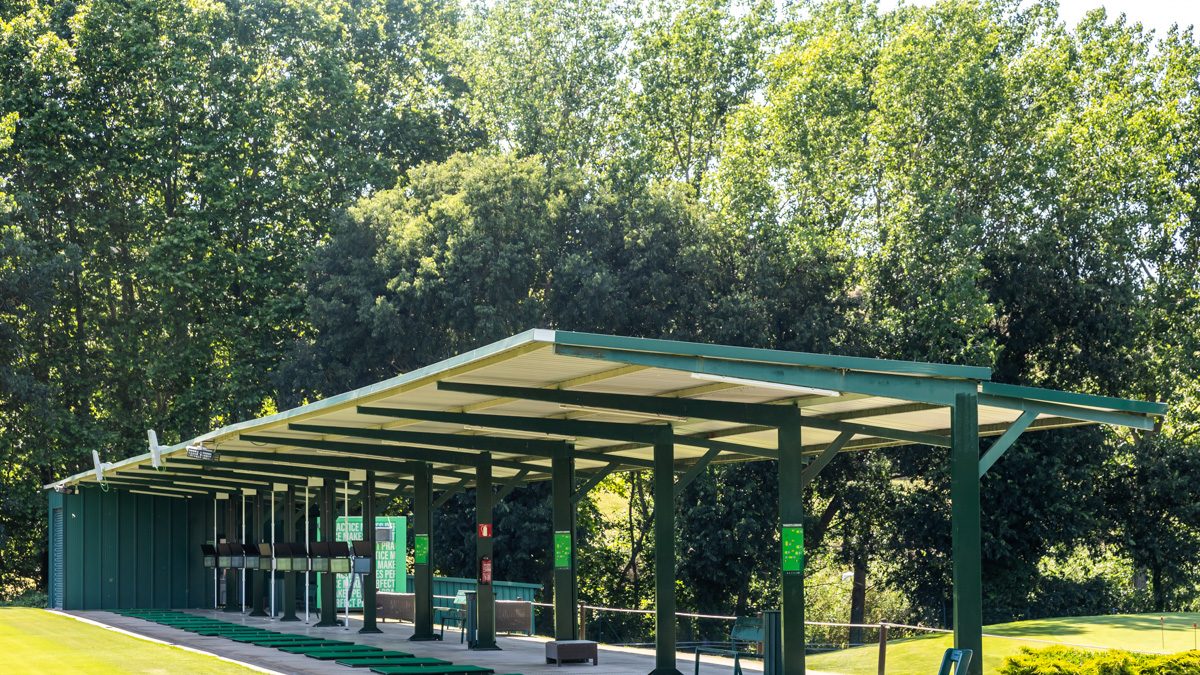
From the living room to the Driving Range: check it works
What you train at home needs to meet a ball, and that’s what the La Roca Golf Training Centre is for. The Driving Range has 33 bays, 21 of them covered, plus floodlights for practice into the evening. If it rains or gets dark early, there’s no need to change your plans. For putting, the putting green covers 1,000 m² with every kind of slope.
A good way to close the loop: ask a La Roca Golf Academy coach to look at your swing and tell you which home drill suits you best. A few golf lessons in Barcelona at the right time stop you grooving a faulty move in your living room. And on the day you play, start with the 15-minute golf warm up so you reach the first tee with your body ready.
Frequently asked questions about golf swing exercises at home
Can you improve your golf swing without going to the course?
Partly, yes. At home you can improve posture, rotation, arm and body connection, putting and strength. What you can’t check is ball flight: for that you need to hit balls at the Driving Range or on the course.
How many days a week should I practise at home?
We suggest three days of swing exercises of about 15 minutes and, on two of those days, 15 more minutes of strength. Short, frequent sessions beat one long session now and then.
Which club should I use at home?
A short club, such as a wedge or a 9-iron, gripped down the shaft. Many drills can be done with no club at all. Keep the driver out of the house.
Can I hit balls at home?
We don’t recommend it with real balls: they break things and can hurt someone. Putting on the rug, yes. For the full swing, the place is the Driving Range.
Do strength exercises help you hit the ball further?
According to the review of 20 studies by Uthoff et al. (2021), yes: strength training improves clubhead speed and distance, especially when it includes golf-specific movements.
From your living room to the tee: come and play at La Roca Golf
Fifteen minutes at home keeps your swing alive; the course turns it into shots. When you want to put your work to the test, the Driving Range, the putting green and the La Roca Golf Academy coaches are waiting for you 30 minutes from Barcelona.
Ready to take your swing from the living room to the Driving Range? See practice and lesson options on our services and rates page or ask the club directly.